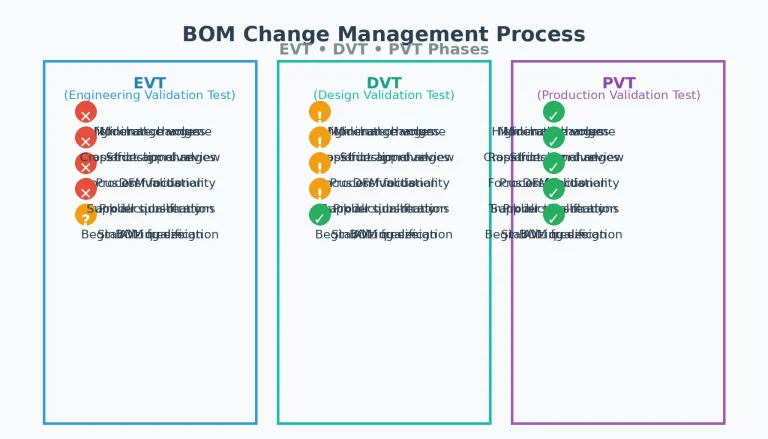
How to Manage BOM Changes Throughout EVT, DVT, and PVT Phases
Learn how to implement effective BOM change management processes throughout EVT, DVT, and PVT phases for successful hardware manufacturing in China.
Read the guide →China NPI Support for Smart Hardware Teams
We help overseas founders and brands validate product feasibility, review BOM cost, select suitable Chinese factories, manage prototypes, and move from pilot run to production.
Best for smart appliances, IoT devices, smart pet products, smart home devices, and connected consumer hardware.
Many overseas teams come to China with a promising hardware idea, but without a clear product brief, realistic BOM target, supplier strategy, or prototype-to-production roadmap.
Factories quote based on assumptions when requirements are unclear, leading to mismatched expectations and rework.
The cheapest supplier may not have the right engineering capability, MOQ fit, quality system, or export experience.
Components, tooling, testing, packaging, certification, and pilot production can change your product economics quickly.
A working prototype does not mean the product is ready for mass production.
Certification risks discovered too late can lead to redesigns, delays, and unexpected costs.
Without pilot run discipline, small problems can become expensive production issues.
We are not a traditional sourcing agent that simply sends you a list of factories. We help you connect product decisions with manufacturing realities — from requirements and BOM cost to supplier fit, prototype milestones, pilot run readiness, and production follow-up.
Clarify what should be built, what should be simplified, and what must be validated before manufacturing.
Identify the right type of Chinese factory based on product category, volume, engineering support, and quality expectations.
Support the structured path from sample and prototype to EVT, DVT, PVT, pilot run, and production.
Core Offer
Before committing to tooling, factory contracts, or a full development budget, get a clear view of your product’s China manufacturing path.
Translate product ideas into practical requirements that factories and engineering partners can understand.
Identify major cost drivers, component risks, tooling considerations, and design-to-cost opportunities.
Prepare RFQ materials, compare suppliers, and evaluate factory fit beyond unit price.
Coordinate samples, EVT/DVT/PVT milestones, issue tracking, and engineering feedback.
Support production readiness, QC planning, inspection coordination, and manufacturing progress tracking.
Understand product concept, target market, must-have features, timeline, and budget assumptions.
Review development route, BOM risks, supplier type, certification concerns, and key unknowns.
Identify the right manufacturing clusters and supplier profiles for the product.
Prepare supplier communication, compare quotes, request samples, and evaluate early fit.
Manage issue tracking, sample iterations, validation milestones, and DFM feedback.
Support pilot run readiness, QC planning, inspection coordination, and production follow-up.
Feeders, water fountains, trackers, litter devices, and connected pet accessories.
Sensors, controllers, small connected devices, and lifestyle hardware.
Coffee makers, cooking accessories, countertop appliances, and smart food-related devices.
Beauty tools, hair care devices, wellness hardware, and small electronic appliances.
Connected modules, environmental sensors, monitoring devices, and control hardware.
Productivity tools, smart displays, desk gadgets, and connected lifestyle products.
For heavily regulated products such as medical devices, children’s safety products, automotive electronics, or high-power appliances, start with a feasibility review before supplier engagement.
We understand how requirements, technical trade-offs, cost targets, and manufacturing constraints interact.
We help you work closer to Chinese suppliers, with clearer communication and faster issue discovery.
We focus on the right type of factory, not random supplier lists.
We identify manufacturing, cost, compliance, tooling, and production risks before they become expensive.
We help bridge overseas product teams and Chinese manufacturing partners.
You get actionable recommendations, not vague consulting slides.
You can — but if your product brief is unclear, the factory may quote based on assumptions that do not match your real goals.
Factories are optimized to manufacture. They may not help you compare development routes, challenge your feature scope, review BOM risks objectively, or tell you that your product is not ready for tooling.
We help you prepare before you commit, so factory conversations become more accurate, efficient, and productive.
Not exactly. We focus on smart hardware manufacturing readiness, including product requirements, BOM cost, supplier fit, prototype milestones, NPI risks, pilot run preparation, and production follow-up.
Yes. If you only have an idea, the best starting point is a feasibility sprint to clarify the development route, cost drivers, supplier type, and major risks.
Yes, but we usually recommend reviewing product feasibility and RFQ readiness first. A better brief leads to better supplier matches and more accurate quotations.
No. We help reduce risk and improve decision-making, but final cost and certification outcomes depend on product design, supplier terms, testing, and production execution.
Email us or submit your project through the contact form. If there is a fit, we usually recommend starting with a 7-day feasibility sprint.
Practical guides on feasibility, BOM cost, factory selection, and EVT/DVT/PVT from our resource center.
Learn how to implement effective BOM change management processes throughout EVT, DVT, and PVT phases for successful hardware manufacturing in China.
Read the guide →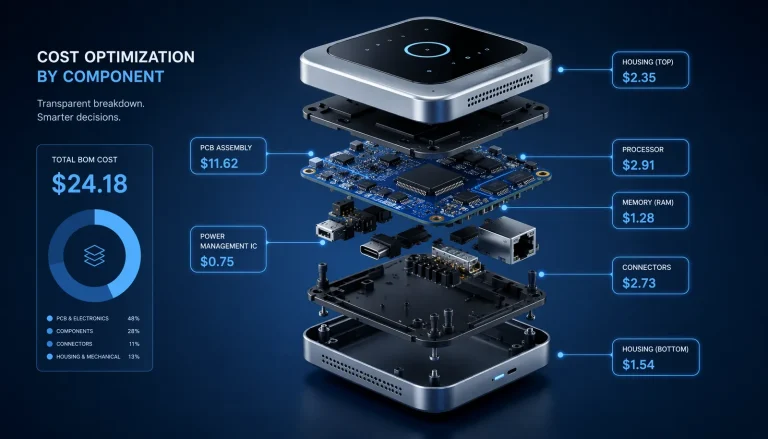
Learn proven BOM cost reduction strategies for hardware products manufactured in China — from component sourcing and DFM to supplier consolidation and MOQ negotiation.
Read the guide →
Minimum order quantities are one of the biggest friction points when working with China factories. Here is how to negotiate MOQs that work for your hardware startup volume and timeline.
Read the guide →Tell us where you are in the process. We’ll help you understand whether your next step should be feasibility review, supplier selection, prototype management, or production follow-up.
Not ready to reach out? Explore our resources on smart hardware manufacturing.