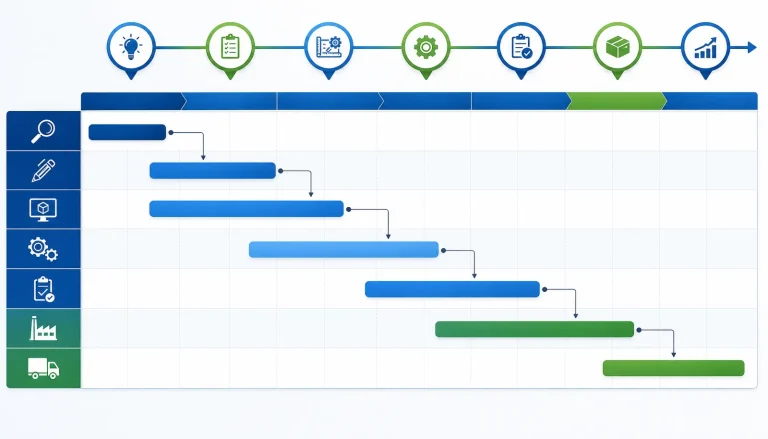
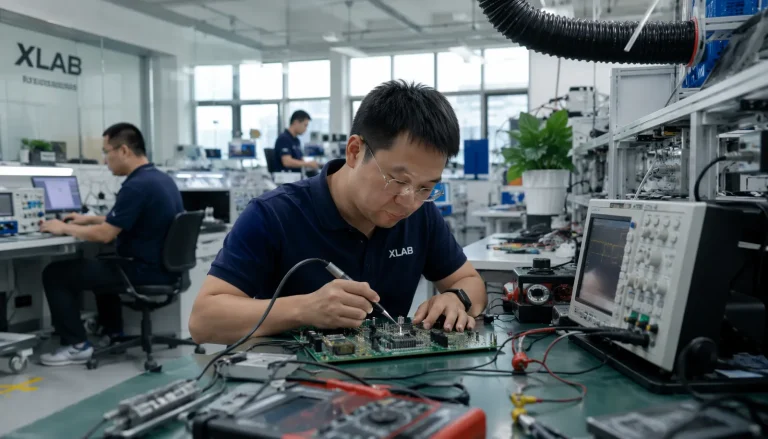
Managing Bill of Materials (BOM) changes effectively throughout the Engineering Validation Test (EVT), Design Validation Test (DVT), and Production Validation Test (PVT) phases is critical for successful hardware manufacturing in China. Without proper change control, BOM modifications can introduce hidden risks, cause delays, and increase costs.
Why BOM Change Management Matters During NPI
During EVT, DVT, and PVT, your design is still evolving. Components get substituted, suppliers change, and designs are tweaked based on test results. Each change introduces potential risks:
- Compatibility issues between new and existing components
- Supplier quality or reliability concerns
- Unanticipated cost impacts
- Lead time disruptions
- Compliance or certification implications
Without a structured process, these changes accumulate silently until they cause problems during pilot production or even after launch. For a broader overview of validation phases, see our guide on EVT, DVT, and PVT explained for hardware founders.
Building Your BOM Change Management Process
Here’s a practical framework you can implement immediately:
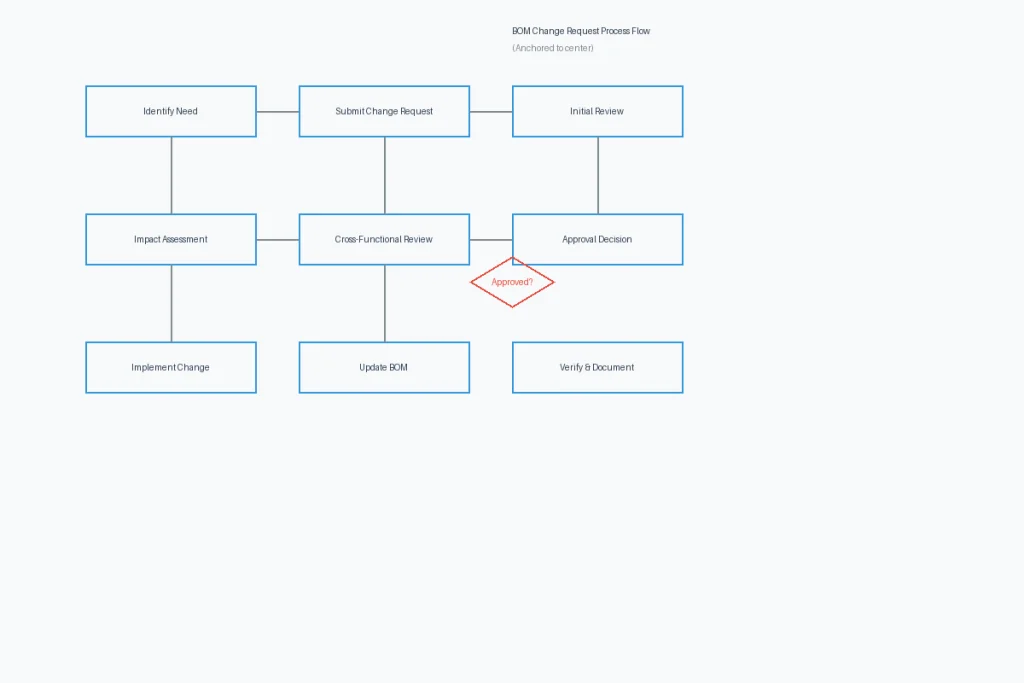
1. Establish a BOM Change Request System
Create a simple but standardized way to propose changes. This could be:
- A shared spreadsheet with columns for: Change Request ID, Date, Requested By, Part Reference, Change Description, Reason for Change, Impact Assessment, and Approval Status
- A shared document or wiki page
- A lightweight ticket in your project management tool
Each change request should answer:
- What exactly is changing? (Include old and new part numbers/names)
- Why is the change needed? (Test failure, cost reduction, availability issue, etc.)
- What are the potential impacts? (Functional, cost, schedule, quality, compliance)
- Who needs to review/approve? (Electrical, mechanical, firmware, quality, procurement)
2. Define Clear Review and Approval Workflow
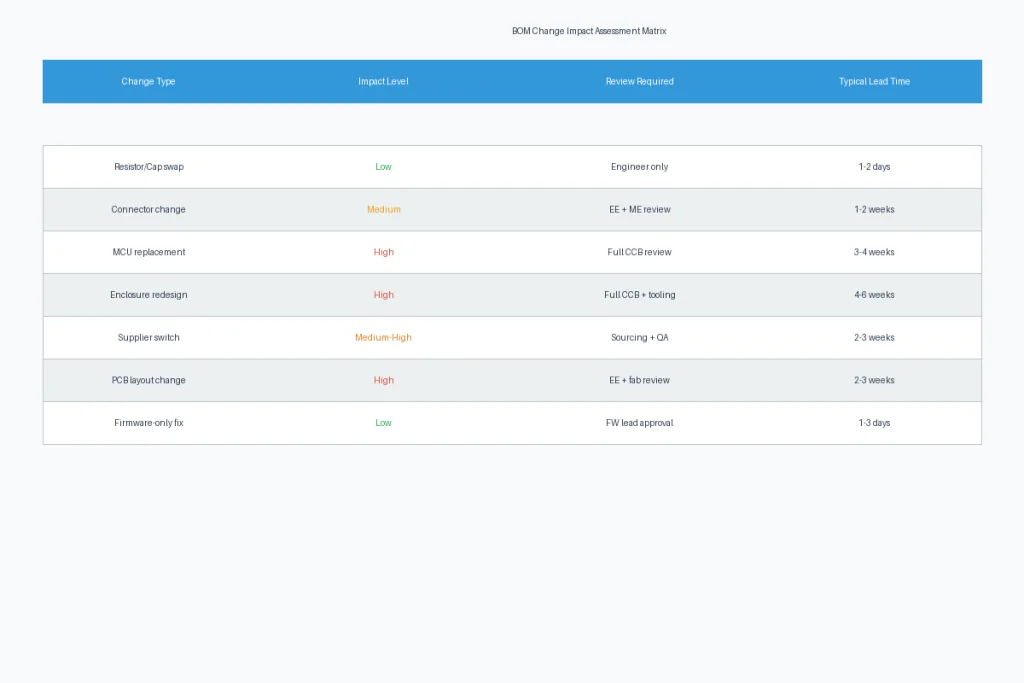
Not all changes require the same level of scrutiny. Create tiers based on impact:
- Low Impact Changes (e.g., equivalent resistor tolerance adjustment): May only need engineer approval
- Medium Impact Changes (e.g., connector substitution): Requires electrical + mechanical review
- High Impact Changes (e.g., microprocessor change, major mechanical redesign): Requires full cross-functional review
Set clear SLAs for review turnaround—aim for 24-48 hours for most changes to maintain development velocity.
3. Implement Impact Assessment Checklist
For each change request, evaluate:
- Form, Fit, Function: Will the change affect physical dimensions, electrical characteristics, or behavior?
- Supplier Qualification: Is the new supplier approved? Do they have adequate capacity and quality systems?
- Cost Implications: Include piece price, tooling, testing, and potential scrap/rework costs
- Lead Time Changes: How will this affect your production schedule?
- Compliance Impact: Does this affect regulatory certifications (FCC, CE, UL, etc.)?
- Inventory Impact: Will this create obsolescence or require dual-bin management?
4. Maintain a Change Log
Keep a master log of all approved changes that includes:
- Change description and date implemented
- Parts added/removed/modified
- Reason for change
- Approved by and date
- Location in BOM where change was made
This log becomes invaluable for troubleshooting, audit trails, and informing future projects.
Phase-Specific Considerations
EVT (Engineering Validation Test)
Characteristics: Early prototypes, focus on basic functionality, frequent design changes
BOM Management Focus:
- Expect high change volume—focus on tracking rather than prevention
- Document all engineering substitutions and “flywire” fixes properly in BOM
- Begin qualifying alternate sources for critical long-lead items
- Start building your approved vendor list (AVL)
DVT (Design Validation Test)
Characteristics: Pre-production prototypes, focus on reliability and design refinement
BOM Management Focus:
- Change rate should begin decreasing as design stabilizes
- Focus shifts to design for manufacturability (DFM) and cost optimization
- Begin formal supplier qualification for production-intent parts
- Start preliminary production process feasibility studies
PVT (Production Validation Test)
Characteristics: Production-intent prototypes on production lines, focus on process validation
BOM Management Focus:
- Changes should be minimal and exceptional by this stage
- Any change requires thorough impact analysis—you’re now validating the production process
- Focus on supplier consistency and process capability
- Prepare for production launch by locking down the BOM
Working Effectively with Your China Manufacturing Partner
Your China factory plays a critical role in BOM change management. For a deeper look at cost analysis, see our BOM and Manufacturing Cost Review service:
Early Involvement
Involve your manufacturing engineer (ME) or process engineer early—engineer (PE) in DVT when you’re finalizing designs for manufacturability. They can often suggest alternative components that are easier to source, assemble, or test locally.
Clear Communication Protocols
Establish how and when BOM changes will be communicated:
- Define lead times required for different types of changes
- Establish who at the factory needs to be notified (materials engineer, production planner, quality engineer)
- Agree on how changes will be documented in their systems
Leverage Local Supplier Relationships
Your China NPI partner often has established relationships with local component distributors and manufacturers. They can help you:
- Find alternate sources for obsolete or long-lead parts
- Qualify new suppliers more quickly
- Navigate local certification requirements
- Access better pricing through volume consolidation
Common Pitfalls to Avoid
1. “Flywire Syndrome”
Undocumented wire fixes or component substitutions made during debugging that never make it back into the official BOM. These create version control nightmares and can cause field failures.
Solution: Create a “deviation log” during debugging, then formally review each item to determine if it requires a BOM change, process change, or design fix.
2. Ignoring the Ripple Effect
Changing a seemingly minor component (like a connector or fastener) without considering secondary effects on assembly time, tooling requirements, or test fixtures.
Solution: Always ask “What else might this affect?” and consult with manufacturing and test engineers.
3. Supplier Qualification Gaps
Switching to a new supplier based solely on price or sample quality without verifying their ability to meet production volume and quality requirements consistently.
Solution: Implement a tiered qualification process: sample approval → small pilot run → process audit → full production approval.
4. Poor Change Communication
Assuming that sending an email constitutes proper change notification, leading to missed changes and confusion on the production line.
Solution: Implement a formal change notification system with acknowledgment requirements and update cycles for your manufacturing BOM and work instructions.
Tools and Templates to Get Started
You don’t need expensive PLM software to start. Here are lightweight options:
Spreadsheet-Based System
Create these tabs in a shared workbook:
- Master BOM: Your current approved bill of materials
- Change Request Log: All proposed changes with status tracking
- Approved Changes: History of implemented changes
- Approved Vendor List (AVL): Qualified suppliers for each part
- Change Impact Assessment Template: Standard form for evaluating changes
Document-Based System
Use shared documents with clear naming conventions:
- BOM_CURRENT_YYYYMMDD.xlsx
- CHANGE_REQUEST_001_DESCRIPTION.yaml
- CHANGE_LOG_YYYYMMDD.md
Metrics That Matter
Track these indicators to measure the effectiveness of your BOM change process:
- Change Frequency Trend: Number of changes per week should show a clear downward trend from EVT to PVT
- Emergency Change Rate: Percentage of changes made outside the normal process (target: <5% by DVT, <1% by PVT)
- Change-Related Issues: Number of test failures or production issues traced back to inadequate BOM change management
- Average Change Cycle Time: Time from change request to implementation (target: <48 hours for most changes by DVT)
Transitioning to Production Control
As you complete PVT, your BOM change process should evolve into your production change control system:
- Production Part Approval Process (PPAP): Ensure all changing parts have appropriate approval documentation
- Engineering Change Order (ECO) System: Transition to your formal ECO process for production changes
- Supplier Notification: Establish clear protocols for notifying suppliers of changes that affect them
- Customer Notification: If applicable, establish processes for customer-facing changes per your agreements
Conclusion
Effective BOM change management throughout EVT, DVT, and PVT transforms what could be a chaotic source of risk into a controlled progression toward production readiness. By implementing a simple but disciplined process for tracking, reviewing, and approving changes, you gain visibility into your design evolution, reduce surprises, and build confidence with your China manufacturing partners.
Remember: The goal isn’t to eliminate change—it’s to eliminate uncontrolled change. When your team, your quality organization, and your factory can anticipate and prepare for modifications, your entire NPI process becomes more predictable, efficient, and successful.
Related reading: BOM Cost Review for Smart Hardware Manufacturing.
Related reading: From Prototype to Mass Production: A Complete Guide to NPI Hardware Startups in China.