For hardware startups and scale-ups manufacturing in China, the Bill of Materials (BOM) is not just a shopping list — it is the single largest determinant of product profitability. A well-optimized BOM can mean the difference between a healthy 40% gross margin and a product that bleeds cash at every unit sold. Yet many hardware founders treat BOM cost as a fixed number handed down by the factory, missing dozens of levers they can pull at every stage of the NPI cycle.
This guide covers proven BOM cost reduction strategies specifically for hardware products made in China — from component sourcing and DFM to supplier consolidation, MOQ negotiation, and hidden-cost traps that silently inflate your effective BOM. Whether you are in EVT, preparing for pilot run, or already in mass production, there are actions you can take today to lower your cost per unit.
Why BOM Cost Management Defines Hardware Profitability
For most hardware products, the BOM represents 50% to 70% of the total manufactured cost. A 10% reduction in BOM cost flows directly to the bottom line — often doubling net profit for hardware companies operating on thin margins. Yet most product teams focus their cost energy on tooling and NRE (non-recurring engineering), which are one-time expenses, while leaving the recurring BOM cost largely unexamined after the initial quote.
The key insight is that BOM cost reduction is not a single event. It is a continuous discipline that runs from concept design through the end of a product’s life. Each phase of the NPI cycle — from prototyping through EVT, DVT, PVT, and pilot run — offers specific opportunities to reduce cost without compromising quality. The earlier you start, the larger the impact and the lower the engineering change cost.
In China’s manufacturing ecosystem, the relationship between your design choices and your final unit cost is particularly direct. Unlike contract manufacturing in some regions where the supply chain is opaque and fixed, China’s open component ecosystem allows you to actively shop, substitute, and negotiate — but only if you know where to look and what levers to pull.
Strategic Component Sourcing in China
Component sourcing is the single biggest lever for BOM cost reduction, yet it is the most underutilized by first-time hardware founders. Many startups accept the factory’s recommended component list without understanding that they are paying a significant markup for the convenience of a pre-sourced BOM.
The first rule of strategic sourcing is to understand the three tiers of component availability in China:
- Tier 1 — Commodity components (resistors, capacitors, connectors, basic ICs): These are widely available from dozens of distributors. Price differences between suppliers can be 20–40% for identical parts. The key is to source from tier-1 authorized distributors (WPG, Arrow, Avnet have strong China operations) rather than letting your factory mark up on pass-through.
- Tier 2 — Critical semiconductors (MCUs, sensors, wireless modules, power management ICs): These often have long lead times and limited second-source options. Your leverage here is volume commitment and early design-in with the manufacturer’s field application engineers (FAEs).
- Tier 3 — Custom tooled parts (plastic enclosures, metal brackets, overmolded cables, PCBAs with custom stackups): These are quoted per your design. The cost reduction lever here is entirely DFM-driven (covered in the next section).
For Tier 1 components, a simple but effective strategy is to request an unbundled BOM quote from 2–3 independent China-based component distributors. Compare their prices against the factory’s consolidated BOM quote. In our experience working with hardware clients, the markup on commodity components alone can account for 8–15% of total BOM cost. Sourcing these components yourself and providing them as customer-supplied material (CSM) or negotiating a cost-plus arrangement with the factory can recover most of that margin.
A word on counterfeits: China’s component market is vast and includes both genuine and counterfeit parts. Always source authorized or reputable distributor lines for safety-critical components (battery management ICs, power regulators, wireless modules). The cost of a field failure from a counterfeit part far exceeds any saving on the BOM line item.

DFM as Your First Cost Reduction Lever
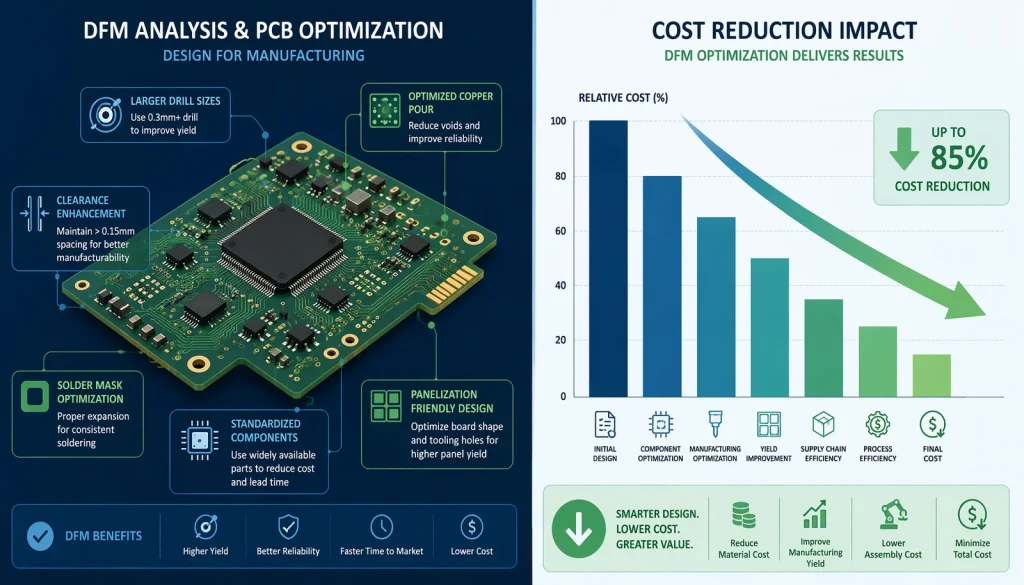
Design for Manufacturing (DFM) is the most powerful cost reduction tool available during the product development phase, yet many startups treat it as a checklist item rather than a strategic cost lever. A thorough DFM review of your design before tooling kickoff can reduce your final unit cost by 15–30% without changing the product’s function or user experience.
Here are the highest-impact DFM cost reduction areas for hardware manufactured in China:
- PCB panel optimization: The single largest PCB cost driver is not the board area but the panel utilization. A layout that wastes 15% of panel space costs 15% more per board. Your contract manufacturer (CM) can advise on optimal panelization during your prototype and NPI management phase. Round corners, standard thickness, and panel-friendly component placement can yield 10–20% savings on PCB fabrication alone.
- Component standardization: Every unique part number on your BOM adds procurement, inventory, and qualification cost. Replacing four different resistor values with two common values, or three connector types with one, reduces not just unit cost but supply chain complexity. A component consolidation pass during DVT can eliminate 10–15% of line items.
- Wall thickness and draft angles: For injection-molded parts, wall thickness directly determines cycle time and material usage. Reducing wall thickness from 2.5mm to 2.0mm can cut cycle time by 20% and material cost by 15%, with no visible difference in the finished product. Similarly, optimizing draft angles reduces tool wear and scrap rate.
- Assembly-friendly design: Design choices that eliminate secondary operations (hand soldering, manual alignment, post-mold finishing) are pure profit. A single snap-fit that replaces a screw reduces assembly time by 5–10 seconds — at 50,000 units, that is 70–140 hours of labor saved.
For a deeper treatment of this topic, see our sister guide on DFM for hardware products, which covers DFM principles in greater technical detail.
Supplier Consolidation and Volume Negotiation Tactics
One of the most common mistakes hardware startups make is spreading their BOM across too many suppliers. A typical smart hardware product might have 30–50 line items sourced from 10–15 different suppliers. This fragmentation destroys your purchasing leverage and multiplies your logistics and quality management overhead.
The consolidation strategy works as follows: identify the 5–8 suppliers that cover 80% of your BOM value (using a Pareto analysis on your BOM). Then negotiate with each of them to take on adjacent line items — even if their price on the new items is not the cheapest. The logic is that the total cost of ownership (purchase price + logistics + quality inspection + payment terms + lead time reliability) is often lower with a consolidated supplier, even at a slight per-item premium.
When you consolidate and grow volume with key suppliers, you create leverage for negotiation on several fronts:
- Price breaks at volume thresholds: Most suppliers have tiered pricing that is not automatically offered. A request like “we commit to 50,000 units over 12 months across these three part numbers — what is your best blended price?” can unlock discounts of 10–25% compared to buying each line item separately.
- Extended payment terms: For startups managing cash flow, moving from 30-day prepayment to net-60 or net-90 after establishing a track record with a supplier can be as valuable as a direct price reduction.
- Inclusion of value-added services: Consolidated suppliers are more willing to include services like kitting, basic testing, or drop-ship to your CM at no extra charge — savings that never show up as a line-item reduction but lower your effective BOM cost.
When evaluating suppliers, our supplier selection and RFQ service can help you build a structured evaluation framework that considers total cost rather than unit price alone.
MOQ Optimization Without Sacrificing Flexibility
Minimum order quantities (MOQs) are a persistent challenge for hardware startups, especially for custom parts like injection-molded enclosures, custom cables, and branded packaging. A high MOQ locks up working capital and creates inventory risk. But there are several strategies to manage MOQs without paying a premium:
- Standardize across stock-keeping units (SKUs): If your product comes in three colors, use the same PCB, same packaging box blank, and same cable — only the cosmetic outer differs. This lets you hit MOQs across variants with a single production run.
- Negotiate MOQ on total BOM value, not per line item: Many factories are more flexible on custom-part MOQs if you give them a larger total production order. A bundled approach (“50,000 units across three variants, all produced in a single calendar quarter”) can reduce per-part MOQs by 30–50%.
- Pool MOQs with complementary products: If you have multiple products sharing the same factory, combine their orders for common components. The factory cares about total run volume, not which product consumes which part.
- Accept a price step at lower MOQs: Some suppliers will accept a lower MOQ in exchange for a per-unit premium of 10–20%. For early-stage validation runs (500–1,000 units), this trade-off can be financially rational compared to over-ordering.
For a detailed walkthrough of MOQ strategy, see How to Negotiate MOQ with China Factories, which covers negotiation tactics and common pitfalls in depth.
Hidden Costs That Inflate Your Effective BOM
Your effective BOM cost is higher than the sum of the part prices on your spreadsheet. Several hidden cost categories routinely add 10–25% to the effective BOM for hardware manufactured in China:
- Scrap and yield loss: If a PCB assembly process has a 3% first-pass yield loss, that 3% is effectively a tax on every good unit’s BOM cost. Investing in quality control during pilot run and production follow-up to identify and reduce scrap drivers pays for itself many times over.
- Obsolescence and last-time buy risk: Semiconductor lead times and end-of-life notices can force last-time buys that lock up cash and inflate inventory carrying costs. A BOM review that identifies single-source components and qualifies alternatives is a cost reduction investment, not an engineering expense.
- Expedite and air freight premiums: When a component is delayed and you need to air-freight a partial shipment, the logistics premium can add 5–15% to your total cost of goods sold for that batch. Building buffer time into your NPI schedule and qualifying second sources for long-lead items are the cheapest insurance against these surprise costs.
- Testing and rework overhead: Every unit that fails functional test and requires rework carries a hidden cost: debug time, replacement components, second test cycle, and delayed shipment. DFM and thorough DVT validation reduce rework rates significantly.
- Packaging and kitting inefficiency: Custom packaging that is not optimized for shipping cube can double your freight cost per unit. Standardizing packaging dimensions and working with your CM on bulk packaging for inbound logistics can reduce this surcharge.
Building a BOM Cost Reduction Roadmap Across the NPI Cycle
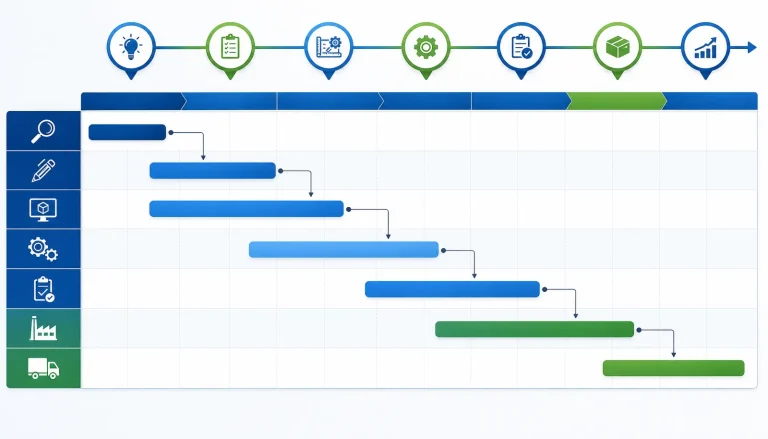
BOM cost reduction is most effective when planned as a phase-gated activity across the NPI cycle, rather than a panicked exercise when margins come in too thin. Here is a recommended roadmap:
| Phase | Key Cost Reduction Activity | Potential Impact |
|---|---|---|
| Concept / Design | Select standard ICs and components with multiple sources; avoid proprietary parts | 20–30% (design choice) |
| EVT | DFM review focused on PCB panelization, component consolidation, and assembly simplification | 15–25% |
| DVT | Supplier RFQ for top-10 BOM items; negotiate volume pricing commitment | 10–20% |
| PVT | Supplier consolidation analysis; MOQ optimization for custom parts | 5–15% |
| Pilot Run | Yield and scrap rate benchmarking; hidden cost analysis | 5–10% |
| Mass Production | Quarterly BOM re-negotiation; second-source qualification for top-3 cost components | 3–8% |
The cumulative impact of running a structured BOM cost reduction program across your NPI cycle is typically 30–50% total cost reduction from the initial prototype BOM to mature mass production pricing. Not all savings are achievable at once — but every phase offers concrete, measurable improvements.
Conclusion: BOM Cost Reduction Is a Competitive Advantage
For hardware startups manufacturing in China, BOM cost is not a fixed input — it is a competitive variable. The teams that treat BOM optimization as an ongoing engineering and sourcing discipline, rather than a one-time negotiation, consistently achieve 20–40% lower unit costs than their peers for products with similar functionality.
The strategies outlined here — strategic component sourcing, DFM-driven design, supplier consolidation, MOQ optimization, and hidden-cost awareness — form a complete toolkit that works at any stage of product development. If your product is already in production, start with the Pareto analysis of your BOM and the consolidation strategy. If you are still in design phase, prioritize DFM and component standardization for maximum leverage.
For a detailed assessment of your current BOM and a customized cost reduction plan, our BOM and manufacturing cost review service provides a structured analysis covering component pricing, supply chain risk, and actionable reduction opportunities specific to your product.